What is Line Rider?
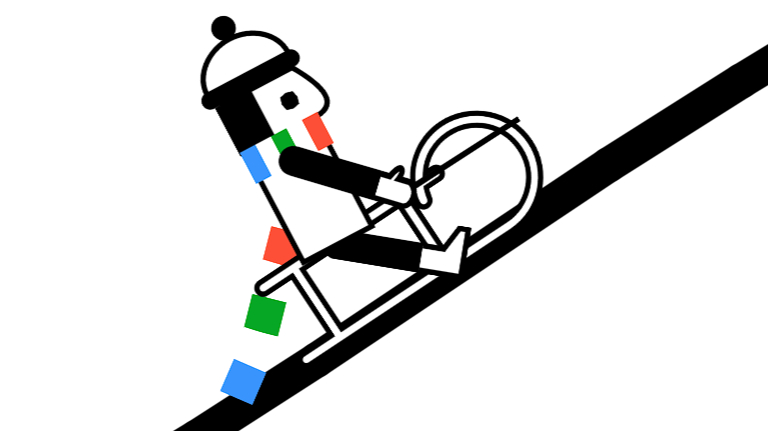
Line Rider is a physics drawing simulation created by Bostjan Cadez in 2006. The central concept involves sketching custom paths on an empty canvas for a sledder to ride down. Instead of racing against opponents or navigating prebuilt stages, you shape the entire landscape using momentum, gravity, and slopes. The simulation plays free in modern desktop and mobile web browsers with nothing to install.
Key features
- Interactive canvas: Sketch custom tracks directly onto a blank drafting surface.
- Realistic gravity simulation: Sled movement reacts dynamically to inertia, steep slopes, and sharp drop-offs.
- Pure sandbox freedom: Experiment without time limits, mandatory objectives, or score requirements.
- Dual orientation support: Play smoothly in either portrait or landscape orientation on mobile and desktop screens.
- Instant iteration: Test your track designs immediately and adjust lines to refine the ride.
How to play
- Open the blank canvas in your web browser.
- Draw a gentle downward slope to give the sledder initial speed.
- Extend the path forward with smooth curves and rolling hills.
- Start playback to watch the sledder slide along your drawn line.
- Identify any sections where the rider loses balance or crashes.
- Adjust your lines to smooth out harsh transitions and keep the run going.
Physics and track construction
Success in Line Rider depends on managing the sledder’s momentum across changing elevations. A steep drop generates rapid acceleration, but hitting an abrupt angle at high velocity will instantly unseat the rider. Creating smooth transitions between downhill sections and level ground preserves forward momentum while keeping the sled stable. By balancing speed with gentle curves, you can craft flowing courses that carry the rider across long distances.
Tips and strategy
- Begin with gradual inclines: Starting with a moderate slope builds controllable momentum without destabilizing the sledder.
- Smooth out sharp corners: Sudden angles disrupt momentum and cause the rider to fall off the sled.
- Build speed before jumps: Ensure the track includes an adequate downhill run before introducing ramps or gaps.
- Test your path frequently: Check playback after adding a few lines rather than sketching an entire long course all at once.
- Leave room for landings: Slope the landing zone downward to match the rider’s flight angle and cushion the return to the track.
Similar games
If you enjoy creative simulations and physics games, check out these titles:
- Car Drawing Game: Draw custom wheels and vehicle shapes to conquer terrain obstacles.
- Sandspiel: Experiment with falling elements and particle physics in a browser sandbox.
- Blob Opera: Create machine learning opera harmonies through expressive vocal characters.
Developer and history
Line Rider was developed by Bostjan Cadez in 2006. The simulation quickly became a widespread internet sensation, captivating players with its blend of physics and creative expression. Today, it remains accessible in HTML5 form for web browsers across desktop and mobile devices.